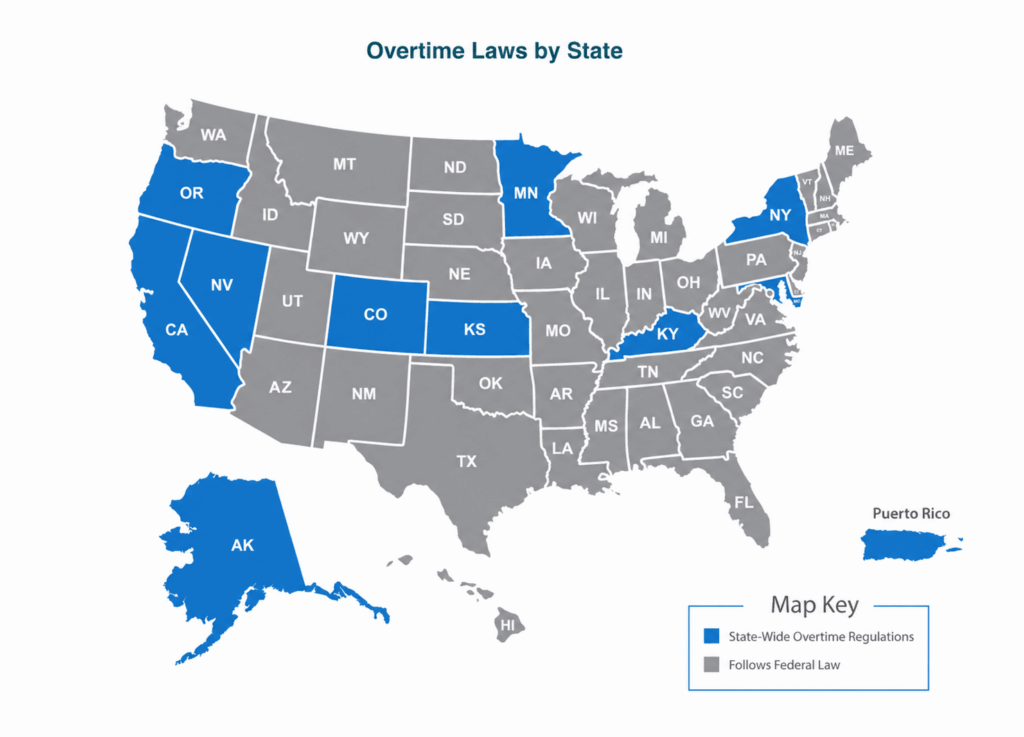


Overtime mistakes are expensive and downright dangerous. A single payroll error can trigger severe penalties, lawsuits, and back pay claims…sometimes costing more than the employee’s original wages. And if your company does business across the country, overtime pay laws and calculations get very complex, very quickly.
The Fair Labor Standards Act (FLSA) establishes some basic ground rules. Per federal law, non-exempt employees earn overtime at 1.5x their regular rate when they work more than 40 hours in a workweek. It sounds simple enough…until you factor in state laws.
Wondering what the overtime rules are in your specific location? Use this guide to learn the basics; then check with a legal expert to make sure your company is compliant.
What Are Overtime Pay Laws?
Overtime pay laws require employers to pay non-exempt employees at higher rates when they work beyond standard hours. These regulations protect workers from exploitation and set clear expectations for employers.
Per the FLSA, employees earn 1.5 times their regular hourly rate for hours worked beyond 40 in a single workweek. This “time and a half” calculation applies to most hourly workers and salaried employees below specific income thresholds.
How Do Overtime Pay Laws Work?
Overtime pay laws are designed to fairly compensate employees for working more than 40 hours/week. In states that follow federal law without additional regulations, here’s how to calculate overtime:
Actual Hours Worked – 40 = Overtime Hours
# Overtime Hours x (Employee’s Regular Pay Rate x 1.5) = Overtime Pay
Here’s where it gets tricky: the workweek doesn’t necessarily align with calendar weeks or pay periods. Employers define their own seven-day cycle and must stick with it consistently. Any hours worked beyond 40 in that defined period will trigger overtime pay.
Certain states have additional overtime laws. In California, for example, employees earn overtime after eight hours in a single day, regardless of their weekly totals. Colorado requires overtime for any work exceeding 12 hours in a day or 12 consecutive hours.
When federal and state rules overlap, employers calculate both ways and pay whichever rate benefits the employee more (DOL).
State vs Federal Laws on Overtime Pay
When you encounter a conflict between state and federal overtime laws, HR should always pay the higher rate, as noted above. If your state has stronger protections than federal law requires, you’ll need to follow the state rules.
Most states follow federal standards with no additional protections. In these locations, employees earn overtime (1.5x standard pay) after 40 hours per week. Some states enforce stricter requirements on top of that baseline.
Who is Exempt from Overtime Pay by Law?
The FLSA exempts certain employees from overtime pay based on their job duties and compensation. These exempt classifications include executive, administrative, professional, computer, and outside sales employees who meet both salary and duties tests.
As of 2026, exempt employees must earn at least $684 per week under federal law. But some states set higher thresholds. For instance, California requires exempt full-time employees to earn twice the state minimum wage.
Note: Some employees (such as nurses and first responders) qualify to pay no tax on overtime per legislation introduced in 2025. HR should work closely with a legal expert to find out how these regulations impact your payroll process.
Overtime Laws by State: Comparison Char
Use this chart to identify specific overtime requirements in the U.S. and Puerto Rico. When state rules conflict with the FLSA, apply whichever law provides greater benefits to your employees.
State | Daily Overtime Laws | Weekly Overtime Laws |
Alabama | N/A | 1.5x standard rate of pay for 40+ hours/week |
Alaska | 1.5x standard rate of pay for 8+ hours/day | 1.5x standard rate of pay for 40+ hours/week |
Arizona | N/A | 1.5x standard rate of pay for 40+ hours/week |
Arkansas | N/A | 1.5x standard rate of pay for 40+ hours/week |
California | 1.5x standard rate of pay for 9-12 hours in a single day1.5x standard rate of pay for the first eight hours worked of seventh consecutive day in a workweek2x standard rate of pay for 12+ hours in a single day2x standard rate of pay for 8+ hours/day of seventh consecutive day in a workweek | 1.5x standard rate of pay for 40+ hours/week |
Colorado | 1.5x standard rate of pay for 40+ hours/week, OR 12+ hours/day, OR any 12 consecutive hours (whichever calculation results in higher pay) | |
Connecticut | N/A | 1.5x standard rate of pay for 40+ hours/week |
Delaware | N/A | 1.5x standard rate of pay for 40+ hours/week |
Florida | N/A | 1.5x standard rate of pay for 40+ hours/week |
Georgia | N/A | 1.5x standard rate of pay for 40+ hours/week |
Hawaii | N/A | 1.5x standard rate of pay for 40+ hours/week |
Idaho | N/A | 1.5x standard rate of pay for 40+ hours/week |
Illinois | N/A | 1.5x standard rate of pay for 40+ hours/week |
Indiana | N/A | 1.5x standard rate of pay for 40+ hours/week |
Iowa | N/A | 1.5x standard rate of pay for 40+ hours/week |
Kansas | N/A | 1.5x standard rate of pay for 40+ hours/week 1.5x standard rate of pay for 46+ hours/week per state law (typically applies to smaller companies that are not required to offer overtime per federal law) |
Kentucky | 1.5x standard rate of pay for work performed on the seventh consecutive day of the workweek | 1.5x standard rate of pay for 40+ hours/week |
Louisiana | N/A | 1.5x standard rate of pay for 40+ hours/week |
Maine | N/A | 1.5x standard rate of pay for 40+ hours/week |
Maryland | N/A | 1.5x standard rate of pay for 40+ hours/week In addition, agricultural workers must be paid 1.5x their standard rate of pay for 60+ hours/week |
Massachusetts | N/A | 1.5x standard rate of pay for 40+ hours/week |
Michigan | N/A | 1.5x standard rate of pay for 40+ hours/week |
Minnesota | N/A | 1.5x standard rate of pay for 40+ hours/week 1.5x standard rate of pay for 48+ hours/week per state law (typically applies to smaller companies that are not required to offer overtime per federal law) |
Mississippi | N/A | 1.5x standard rate of pay for 40+ hours/week |
Missouri | N/A | 1.5x standard rate of pay for 40+ hours/week |
Montana | N/A | 1.5x standard rate of pay for 40+ hours/week |
Nebraska | N/A | 1.5x standard rate of pay for 40+ hours/week |
Nevada | For employees earning <1.5 minimum wage, 1.5x standard rate of pay for 8+ hour/day | 1.5x standard rate of pay for 40+ hours/week |
New Hampshire | N/A | 1.5x standard rate of pay for 40+ hours/week |
New Jersey | N/A | 1.5x standard rate of pay for 40+ hours/week |
New Mexico | N/A | 1.5x standard rate of pay for 40+ hours/week |
New York | N/A | 1.5x standard rate of pay for 40+ hours/week Agricultural workers earn overtime after 52+ hours/week, and any hours worked on their official day of rest Additional occupations qualify as exempt from overtime, such as taxicab drivers |
North Carolina | N/A | 1.5x standard rate of pay for 40+ hours/week |
North Dakota | N/A | 1.5x standard rate of pay for 40+ hours/week |
Ohio | N/A | 1.5x standard rate of pay for 40+ hours/week |
Oklahoma | N/A | 1.5x standard rate of pay for 40+ hours/week |
Oregon | 10+ hours/day (manufacturing only) | 1.5x standard rate of pay for 40+ hours/week |
Pennsylvania | N/A | 1.5x standard rate of pay for 40+ hours/week |
Puerto Rico | 1.5x standard rate of pay for 8+ hours/day 2x standard rate of pay on statutory rest days | 1.5x standard rate of pay for 40+ hours/week |
Rhode Island | N/A | 1.5x standard rate of pay for 40+ hours/week |
South Carolina | N/A | 1.5x standard rate of pay for 40+ hours/week |
South Dakota | N/A | 1.5x standard rate of pay for 40+ hours/week |
Tennessee | N/A | 1.5x standard rate of pay for 40+ hours/week |
Texas | N/A | 1.5x standard rate of pay for 40+ hours/week |
Utah | N/A | 1.5x standard rate of pay for 40+ hours/week |
Vermont | N/A | 1.5x standard rate of pay for 40+ hours/week |
Virginia | N/A | 1.5x standard rate of pay for 40+ hours/week |
Washington | N/A | 1.5x standard rate of pay for 40+ hours/week |
Washington, D.C. | N/A | 1.5x standard rate of pay for 40+ hours/week |
West Virginia | N/A | 1.5x standard rate of pay for 40+ hours/week |
Wisconsin | N/A | 1.5x standard rate of pay for 40+ hours/week |
Wyoming | N/A | 1.5x standard rate of pay for 40+ hours/week |
Which States Do Not Have Weekly Overtime Pay Laws?
No state operates without weekly overtime requirements. Every state follows federal law at a minimum, which mandates overtime pay after 40 hours in a workweek. Some states have additional protections.
States without their own overtime laws must follow federal standards. Employees in these states earn overtime when they work more than 40 hours/week. They are not eligible for additional protections, like overtime for long hours worked in a single day.
States with Daily Overtime Pay Laws
Several states enforce daily overtime thresholds. These laws trigger premium pay (usually 1.5x or 2x the standard rate) before employees reach 40 hours/week.
Alaska
Alaska requires overtime pay after eight hours in a single day at 1.5x the regular rate. This daily threshold works alongside federal weekly requirements, so employees can earn overtime through either calculation, depending on their schedule.
California
California has the strictest daily overtime laws in the nation. Employees earn 1.5x their regular rate for hours 9-12 in any given workday, and for the first eight hours worked on the seventh consecutive day of a workweek.
The state also mandates double-time pay (2x the regular rate) for hours beyond 12 in a single day, and for hours beyond eight on the seventh consecutive workday. As a result, workers receive substantial compensation for extended shifts.
Colorado
Colorado requires 1.5x pay for any work beyond 40 hours per week, OR 12 hours per day, OR 12 consecutive hours. Employers should choose the calculation that results in higher compensation for the employee.
Kentucky
Kentucky employers must provide overtime pay (1.5x standard rate of pay) for work performed on the seventh consecutive day of the workweek. Employers must track consecutive workdays carefully to ensure compliance with both state and federal overtime requirements.
Nevada
Nevada creates a unique threshold tied to wage levels. Employees earning less than 1.5x the minimum wage receive overtime pay after eight hours in a day. This provision protects lower-wage workers from extended shifts without premium compensation. Higher-earning employees in Nevada follow only federal weekly overtime standards.
Oregon
Oregon regulations require daily overtime for manufacturing employees who work more than ten hours in a single day. This industry-specific requirement exists alongside the federal standard for 1.5x pay for more than 40 hours/week.
Puerto Rico
Puerto Rico requires overtime pay after eight hours in a single day at 1.5x the regular rate. The territory also mandates double-time pay (2x the regular rate) for work performed on statutory rest days. Employers must follow these rules in addition to FLSA overtime requirements.
Which States Have Double Overtime Laws?
California is the only U.S. state that requires double-time pay. Puerto Rico, a U.S. territory, also mandates double-time compensation for work on statutory rest days. No other state mandates compensation at 2x the regular rate, though some employers voluntarily offer double-time for various circumstances, such as holiday pay.
California Double Overtime Pay Law
California requires double-time pay (2x the regular hourly rate) in two scenarios:
- Working more than 12 hours in a single day, regardless of weekly hours
- Working more than eight hours on the seventh consecutive day of a workweek
This provision stops employers from using compressed schedules that would otherwise only trigger time-and-a-half. For example, a construction worker who puts in a 14-hour day earns regular pay for the first eight hours, time-and-a-half for hours 9-12, and double-time for hours 13 and 14.
HR can calculate double-time by multiplying the employee’s regular hourly rate by two. For employees with variable rates, use the weighted average of all rates worked during the week.
Which States Do Not Have Daily Overtime Pay Laws?
Most states follow federal overtime standards, with no daily overtime thresholds. Employees in the following locations earn overtime when they work more than 40 hours in a workweek:
- Alabama
- Arizona
- Arkansas
- Connecticut
- Delaware
- Florida
- Georgia
- Hawaii
- Idaho
- Illinois
- Indiana
- Iowa
- Kansas
- Louisiana
- Maine
- Maryland
- Massachusetts
- Michigan
- Minnesota
- Mississippi
- Missouri
- Montana
- Nebraska
- New Hampshire
- New Jersey
- New Mexico
- North Carolina
- North Dakota
- Ohio
- Oklahoma
- Pennsylvania
- Rhode Island
- South Carolina
- South Dakota
- Tennessee
- Texas
- Utah
- Vermont
- Virginia
- Washington
- Washington D.C.
- West Virginia
- Wisconsin
- Wyoming
Some of these states include industry-specific provisions or higher weekly thresholds for certain employers, but none enforce daily overtime requirements that apply across all industries. Be sure to check with a compliance expert to see which exact regulations apply to your business.